
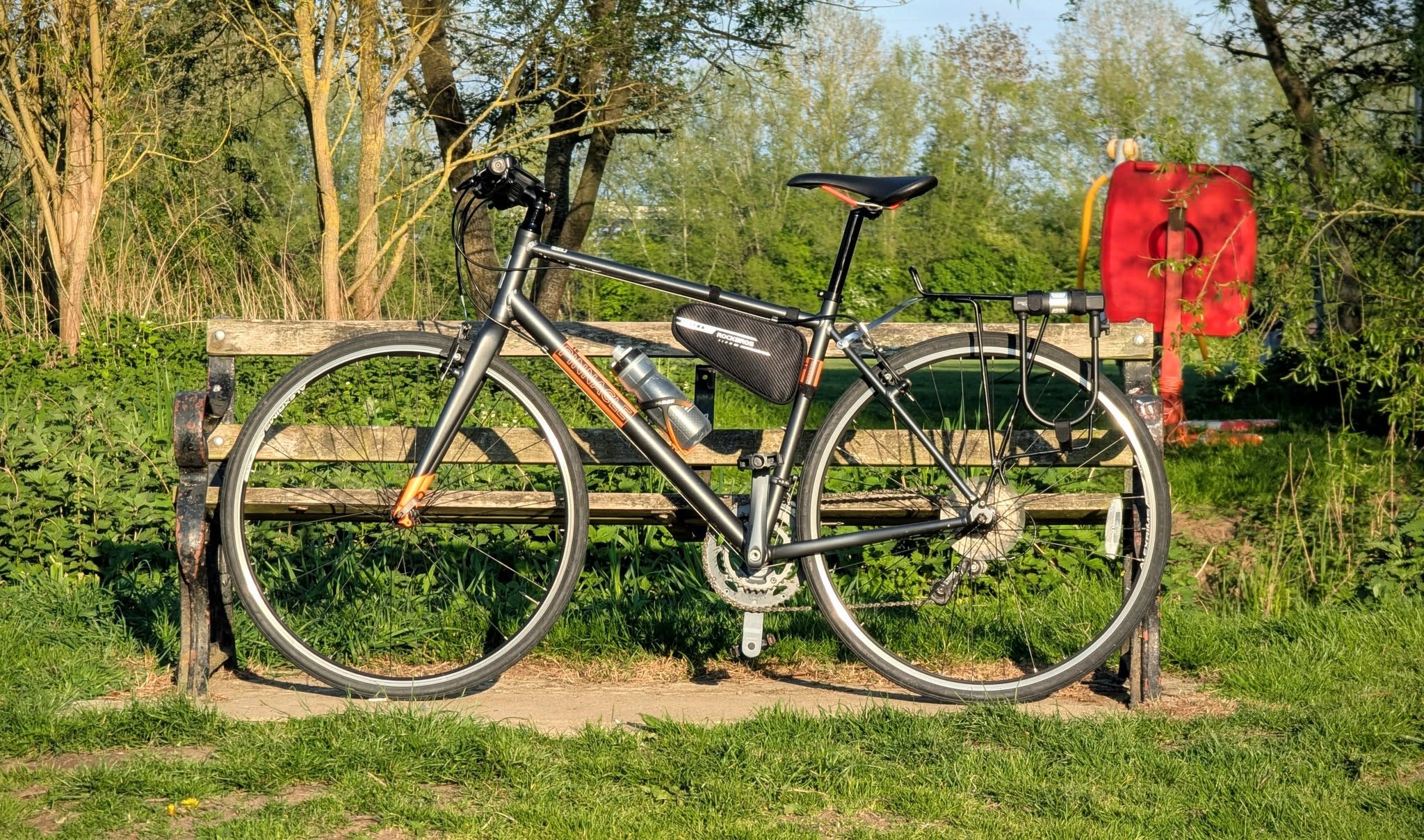
The Pinnacle Neon Two was the middle of the range of three Pinnacle Neon rigid rim-braked hybrid bicycles sold by Evans Cycles in 2015 (e.g. the One had the Acera drivetrain, the Two had Claris, the Three had Sora) with an RRP of £450. Evans Cycles also had a couple of other hybrid models – the Lithium range with disc brakes and the Cobalt range with front suspension. The 2015 Neon was an updated version of the previous iteration first sold in 2012.
The Two uses their Pinnacle 6061-T6 double-butted aluminium alloy frame with an aluminium fork (the Three has a carbon fork). The drivetrain and shifters are Shimano Claris 2400 with 2×8 gears (50/34T chainrings, 11-32T Sun Race cassette). The brakeset is is Tektro RX1 mini-V. The handlebars are aluminium flat bar (600mm wide with a 9 degree back-sweep) on a 105mm stem. Mine is in large size (20″).
I purchased the bike second-hand from a used bicycle dealer in April 2025. It was written off by a careless driver in January 2026.
Modifications/Additions/Maintenance
- Pannier Rack
- A Tortec Tour rack was already fitted when I purchased the bike. As I wanted to keep the mount for my d-lock on the Marin I cable-tied some velcro straps to the pannier rack which I could use to attach the d-lock.
- Bottle Cage
- I found a Hasagei bottle cage with was a mix of neon orange fading to dark grey – a perfect match for the Neon’s colour scheme.
- Mudguards (fenders)
- As summer drew to a close in 2025 I bought a set of SKS Velo 42 Urban mudguards (42mm wide) along with the optional u-stay kit for more secure mounting. They worked pretty well (the photos on this page are all from prior to me fitting them).
- Frame Bag
- I added a small Rockbros frame bag to carry a small toolkit and my keys.
- Rear Derailleur Hanger
- The rear cogs always sounded a little noisy regardless of adjustment. On closer inspection I realised the cage was at a slight angle causing a little chain rub on the cage which was down to hanger being slightly bent (it must have taken a knock before I bought it). I bought a cheap hanger alignment tool and was able to pull it back into line.
- Spoke
- I had a spoke in the rear wheel break on a ride which I had to replace. Fortunately it didn’t break far from home, but that short ride was enough for the wheel to get pulled somewhat out of true so I had to re-true it as well.
- Chain
- As I was coming up to the first year of ownership the drivetrain was still a little noisy and, having read up on chain wear and not knowing how many miles the bike had on it prior to me owning it, I decided to fit a slightly upgraded chain (a KMC EPT – improved rust protection). It was only a few days after fitting it that the accident happened!
Accident Damage
As noted on my page about the accident I got hit by a car while riding this bicycle. I’d steered to avoid it being a head-on the impact and so the car hit around the middle of the bike on the right side (primarily impacting my right leg and sending me and the bicycle through the air separately and rotating the saddle through 45 degrees). I initially thought maybe the bicycle was repairable as there was no immediately obvious frame damage from a quick look (the wheels were clearly now out of true though and the rear gear indexing was off for some reason).
A few days later I had a chance to take a proper look over the bicycle and assess it. I noticed that the rear brake was now able to move far enough inboard before contacting the wheel rim so as to foul part of it on the pannier rack, that the pads were misaligned with the rim, that the rear wheel was misaligned with the rear mudguard and the seat tube (although the wheel had a slight wobble when rotated it didn’t fundamentally affect the misalignment). So I took the rear wheel out, flipped it 180 degrees and put it back in the dropouts – the misalignment remained confirm the frame must have warped. I looked more closely at the chainstays and could see a slight difference in the S shape between the two sides – one slightly more compressed the other slightly more elongated.
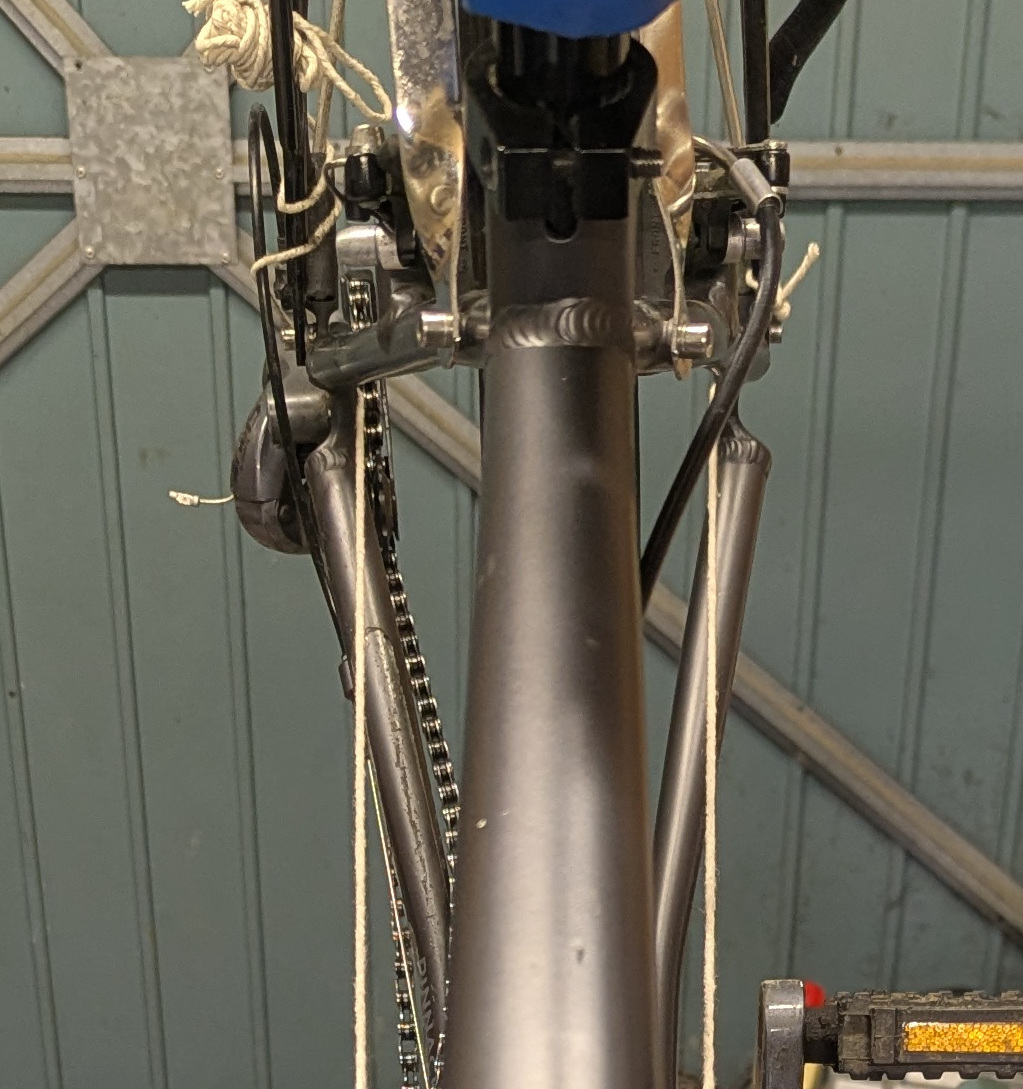
I next used the “string” method to properly check the alignment of the rear triangle – tying one end to the left dropout, running the string taut around the head tube and back to tie on the right dropout to then measure the gap between the seat tube and the string on each side – there was a 15mm difference between the sides at the seat tube. In the photo to the right you can see visually that chainstays are at different distances from the centreline of the bicycle and the string makes that even easier to see. That warping is enough such that the dropouts are now positioned more towards the drive side than they should be and this also potentially has messed with the length of them too – the consequence seeming to be that the rear wheel was now offset to the right and slightly turned to one side (so misaligned with respect to the seat tube and the brakes).
Everything I’ve read says an aluminium alloy frame that has been warped even slightly by force will have been weakened and so has become scrap (and trying to unwarp it will weaken it further). So the bike sadly became a write-off – a bike shop will not repair it and I would not be able to sell it for anything other than spares (and if I did move it on I’d want to make sure the frame is scrapped rather than risk anyone unscrupulous trying to sell it).
Because I hate to see anything with any life still in it thrown away then I did contemplate, if the driver’s insurer didn’t want the written-off bicycle, trying re-dishing the rear wheel to re-centre it to see if it could be made rideable just to use for going into the city centre (Oxford city centre has a lot of bicycle theft so I’d rather not risk my Cannondale). However on further reading I understand that even minor deformations of the heat-treated aluminium alloys used in bicycle frames will weaken it in a way that means the deformed areas are at risk of failing without warning under load (so just regularly inspecting for signs of further warping or of cracking wouldn’t be sufficient to mitigate the risk). Since the chainstays experience lateral loads on cornering in the direction they were warped the risk just isn’t worth taking, and so the frame is truly scrap.